
- October 29, 2026
- 5 mins
AI Has Released Capacity. What Happened to It?
In September 2026, Wipro’s Chief Technology Officer, Sandhya Arun, reported that the company’s artificial intelligence (AI) initiatives had generated productivity equivalent to the output of 20,000 employees.
According to Arun, the employees associated with these productivity gains had been redeployed. This could involve engineers managing multiple AI agents, moving to other projects or receiving training for different roles.
For a company employing approximately 243,000 people at the end of June, this was a significant claim.
But it raises an equally important question: What happened to that capacity, and how should organisations measure its value?
The 20,000 figure represents a company-reported productivity equivalence, rather than an independently verified measure or a count of employees replaced by AI. Nevertheless, it illustrates a measurement challenge facing organisations as AI changes how work is performed.
Productivity Gains Are Only Part of the Story
AI can reduce task completion times, increase output or enable teams to manage greater workloads. Yet time saved does not automatically translate into usable workforce capacity, and additional capacity does not necessarily translate into business value.
An employee who completes a task in two hours rather than four may have time available for other responsibilities. But how much of that time remains after accounting for supervision, verification or rework? And what happens to it?
The Conference Board’s September 2026 research on agentic AI and work redesign reinforces this distinction. Organisations must determine how productivity gains are allocated, whether towards lower costs, improved services, greater output or reduced employee workload.
Similarly, PwC’s Global Workforce Hopes and Fears Survey 2026 highlights that widespread AI adoption will not, by itself, deliver returns without changes to roles, workflows and incentives.
The challenge is to move from reporting AI activity to demonstrating workforce and business outcomes.
2. Distinguish cultural awareness from stereotyping
Cultural awareness helps leaders recognise that people may communicate, collaborate or respond to authority differently. Stereotyping occurs when those general observations are used to make assumptions about an individual.
A leader may, for example, interpret a reserved communication style as a lack of confidence, an assertive style as disrespect, or a preference for consultation as an inability to decide. These judgements can affect who is heard, trusted, promoted or assigned visible responsibilities.
Leaders should assess observable behaviour and work outcomes rather than assumed cultural characteristics. Where a behaviour is unclear, the appropriate response is inquiry rather than interpretation.
Instead of concluding that an employee “lacks executive presence”, a manager should be able to describe the specific behaviour observed, explain its effect and clarify what effective performance would look like.
Three Questions Organisations Should Be Asking
- What productivity improvement has actually occurred?
Organisations need credible evidence of changes in task completion times, output, process efficiency, quality or labour requirements. Reported gains should be supported by appropriate baselines and consistent measurement.
- What happened to workforce capacity and capability?
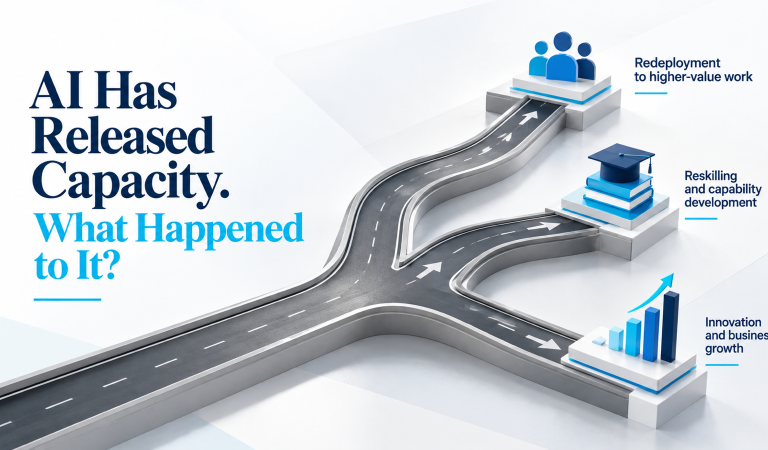
Where AI has genuinely released capacity, was it redirected towards higher-value activities, customer service, innovation or business growth? Were employees redeployed, reskilled or assigned different responsibilities?
Changes in workload and emerging capability requirements also matter.
- What measurable value followed?
Did the organisation reduce costs, improve service quality, increase revenue, avoid additional recruitment or strengthen operational performance?
These outcomes are connected, but they should not be treated as interchangeable. An organisation can report improved efficiency without demonstrating corresponding business value.
What Should People Analytics and Human Capital Reporting Measure?
Traditional workforce measures such as headcount, labour costs and revenue per employee remain relevant. However, their interpretation becomes more complex when organisational output increasingly combines human capability, AI and redesigned workflows.
This is where People Analytics and Human Capital Reporting and Disclosure (HCRD) have an important role.
ISO 30414:2025, Human resource management — Requirements and recommendations for human capital reporting and disclosure, provides a relevant framework. Its Productivity human capital area (HCA) includes measures such as revenue per full-time equivalent (FTE) and human capital return on investment (HCROI).
Importantly, the standard also accommodates organisation-specific metrics where these provide additional, material insights.
One measure organisations could consider developing is an AI-enabled capacity redeployment rate, representing the proportion of verified, usable capacity released through AI that has been redirected towards defined business priorities.
For example, if an organisation establishes that AI-enabled improvements have released 1,000 usable working hours and can demonstrate that 700 hours were redirected to other activities, its redeployment rate would be 70%.
This proposed measure draws on ISO 30414:2025’s provision for organisation-specific metrics and could complement its established productivity measures. Its credibility would depend on reliable baselines, transparent definitions and evidence that usable capacity was genuinely released through AI-enabled changes.
Importantly, it would show where capacity was redirected, but not necessarily the value created. That would require further evidence of workforce and business outcomes, supported by relevant financial and non-financial measures.
From AI Adoption to Measurable Value
As organisations prepare their 2027 priorities, the conversation should extend beyond the number of employees using AI or the hours reportedly saved.
Leaders need to establish what work has changed, how productivity improvements are calculated, where any released capacity has gone and what measurable outcomes have followed.
Wipro’s reported experience illustrates the potential scale of AI-enabled productivity improvements. It also highlights why organisations need to distinguish between reported capacity, workforce redeployment and value realised.
Ultimately, the measure of AI’s contribution is not simply how much time or effort has been saved, but what organisations can demonstrate they have accomplished with the capacity gained.
Further Reading and References
- Reuters (10 September 2026). Wipro’s AI push frees capacity equivalent to 20,000 workers, CTO says.
- The Conference Board (24 September 2026). A Framework for Agentic AI and Work Redesign.
- PwC (29 September 2026). Global Workforce Hopes and Fears Survey 2026.
- International Organization for Standardization (ISO, 2025). ISO 30414:2025, Human resource management — Requirements and recommendations for human capital reporting and disclosure.